Risk Management8 min read
Risk of ruin: why a small edge still needs small risk
Risk of ruin trading explained with the math that matters. See how win rate, payoff, and per‑trade risk interact, and why small risk unlocks a small edge.
By TerraTrade Team

What “risk of ruin” means in trading#
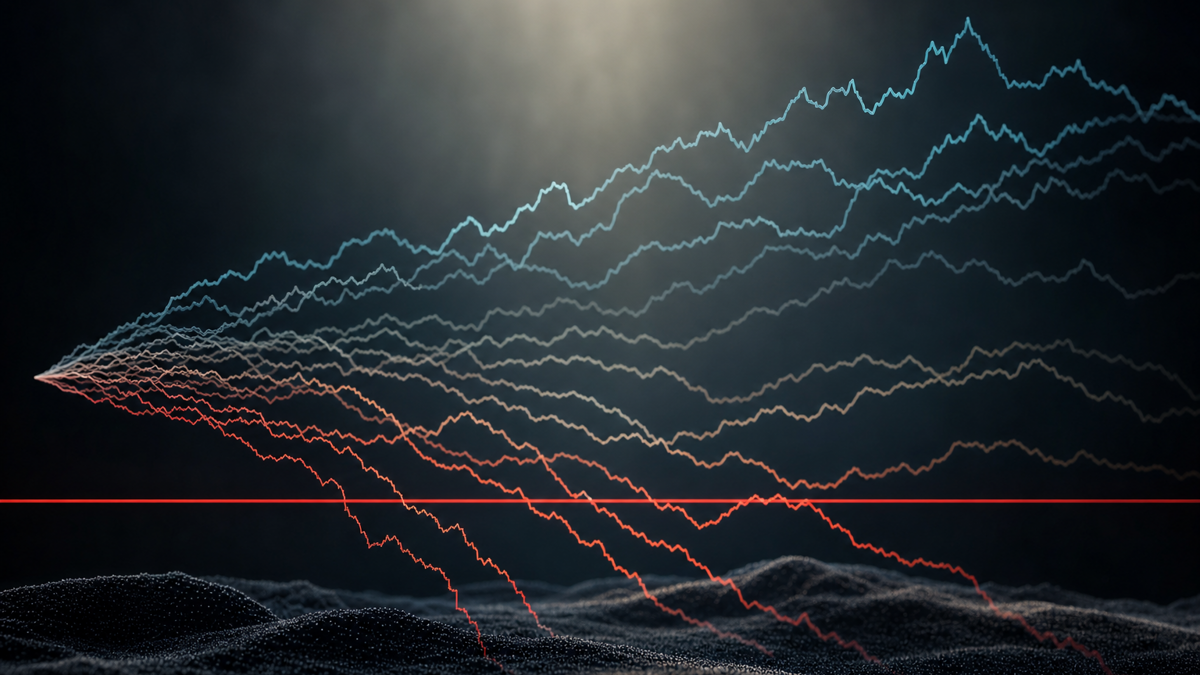
Risk of ruin (RoR) is the probability that your equity hits a predefined “ruin” threshold—such as a stop‑out level, prop‑firm limit, or a capital floor you refuse to cross—before your edge can compound. In other words, it’s the chance your account is knocked out of the game by adverse variance before your average advantage shows up in results Risk of Ruin in Trading: Formula and Assumptions | Costante. RoR turns three ingredients into a survival‑odds estimate: win probability, payoff ratio, and position size measured as risk per trade Risk of Ruin in Trading: What It Is and How to Calculate It.
The levers: win rate, payoff, and bet size#
- Win probability p and loss probability q = 1 − p.
- Payoff ratio R = average win ÷ average loss.
- Risk per trade (in currency or % of equity) defines how many “units” U your account has: U = capital ÷ risk per trade. RoR falls quickly as U grows Risk of Ruin — Probability of Blowing Up, Formula & Example | RiskManagementGyan.
- These inputs interact through gambler’s‑ruin style formulas. The edge comes from both p and R; sizing turns that edge into survival time by stretching the number of units you can lose before crossing your threshold Risk of Ruin in Trading: What It Is and How to Calculate It.
Two commonly used formulas#
Even‑money case (symmetric wins/losses). If each trade wins or loses one unit, with p greater than 0.5 and q = 1 − p, the probability of eventually hitting ruin starting with U units is:
RoR equals (q divided by p) raised to the power U. If p is at most 0.5 in this symmetric setup, eventual ruin is 1.0. This classical result shows RoR shrinking exponentially as U rises Risk of Ruin Calculator · PlusEV Lab.
Asymmetric payoff approximation (more realistic for trading). When average win and loss differ, many risk frameworks approximate RoR as:
RoR is approximately ((1 − E) ÷ (1 + E)) raised to the power U, where E = (p × R) − q and U = capital ÷ risk per trade. This generalizes the same exponential sensitivity to unit size and requires the same independence/constant‑edge assumptions Risk of Ruin — Probability of Blowing Up, Formula & Example | RiskManagementGyanRisk of Ruin in Trading: What It Is and How to Calculate It.
Worked examples you can recreate#
The numbers below are illustrations using the formulas above—not promises. Change any input and recompute to see how quickly RoR responds to sizing.
Example A: small edge, even‑money outcomes#
- Assume p = 0.52 and q = 0.48 (a 2‑point edge), with even‑money wins/losses. Account = $10,000.
- Risk per trade = $200 → units U = 10,000 ÷ 200 = 50.
- RoR = (q ÷ p) raised to the power U = (0.48 ÷ 0.52) raised to 50 ≈ 0.0183 → 1.83% Risk of Ruin Calculator · PlusEV Lab.
- If you double risk to $400 → U = 25: RoR ≈ (0.48 ÷ 0.52) raised to 25 ≈ 0.135 → 13.5% Risk of Ruin Calculator · PlusEV Lab.
- If you halve risk to $100 → U = 100: RoR ≈ (0.48 ÷ 0.52) raised to 100 ≈ 0.000332 → 0.033% Risk of Ruin Calculator · PlusEV Lab.
| Units (U) | Risk per trade (on $10,000) | RoR (p = 0.52, even‑money) |
|---|---|---|
| 100 | $100 | 0.033% |
| 50 | $200 | 1.83% |
| 25 | $400 | 13.5% |
Example B: asymmetric payoff with the common approximation#
Parameters: p = 0.48, q = 0.52, payoff ratio R = 1.2. Edge E = (p × R) − q = (0.48 × 1.2) − 0.52 = 0.576 − 0.52 = 0.056. With account = $10,000:
- Risk $200 → U = 50: RoR ≈ ((1 − 0.056) ÷ (1 + 0.056)) raised to 50 = (0.944 ÷ 1.056) raised to 50 ≈ 0.894 raised to 50 ≈ 0.37%.
- Risk $400 → U = 25: RoR ≈ 0.894 raised to 25 ≈ 6.1%.
- Risk $100 → U = 100: RoR ≈ 0.894 raised to 100 ≈ 0.00136%.
These numbers show the same exponential sensitivity: cutting risk per trade multiplies units and drives RoR down sharply Risk of Ruin — Probability of Blowing Up, Formula & Example | RiskManagementGyanRisk of Ruin in Trading: What It Is and How to Calculate It.
A quick procedure to estimate your own RoR#
- Define the ruin threshold you care about (e.g., max drawdown from start or peak, static equity floor, or firm rule) Risk of Ruin in Trading: Formula and Assumptions | Costante.
- Estimate p (win rate) and R (average win ÷ average loss) from a sufficiently large, like‑for‑like sample of your trades (same instruments, sessions, and rules) Risk of Ruin in Trading: What It Is and How to Calculate It.
- Choose a risk per trade in currency or percent. Compute units U = capital ÷ risk per trade Risk of Ruin — Probability of Blowing Up, Formula & Example | RiskManagementGyan.
- If your average win equals average loss (R ≈ 1), use the even‑money formula: RoR equals (q ÷ p) raised to the power U for p greater than 0.5; if p is at most 0.5, RoR = 1 in that symmetric case Risk of Ruin Calculator · PlusEV Lab.
- If R ≠ 1, use the common approximation RoR ≈ ((1 − E) ÷ (1 + E)) raised to the power U with E = (p × R) − q, and treat results as estimates under the model’s assumptions Risk of Ruin — Probability of Blowing Up, Formula & Example | RiskManagementGyanRisk of Ruin in Trading: What It Is and How to Calculate It.
- Sanity‑check your math with a reputable RoR calculator that implements gambler’s‑ruin logic and try several risk levels (U values) to see the curve of outcomes Risk of Ruin Calculator · PlusEV LabRisk of Ruin Calculator — gambler's ruin for traders | TradeOnMath.
- Stress test: repeat with slightly worse p or R to see how estimation error or regime change could raise RoR Risk of Ruin in Trading: Formula and Assumptions | CostanteRisk of Ruin in Trading: What It Is and How to Calculate It.
Why small risk unlocks a small edge#
- Because RoR scales like a raised to the power U with a between 0 and 1 (exclusive), halving risk per trade (doubling U) roughly squares the RoR figure—pushing it down much faster than modest tweaks to p or R can Risk of Ruin — Probability of Blowing Up, Formula & Example | RiskManagementGyanRisk of Ruin in Trading: What It Is and How to Calculate It.
- Edge is necessary but not sufficient. A positive E or p greater than 0.5 does not make RoR vanish for finite U; only very large U can make it negligible in practice Risk of Ruin Calculator · PlusEV Lab.
- Sizing buys time. More units mean more independent trials before touching the threshold, letting a small advantage average out Risk of Ruin Calculator · PlusEV Lab.
- Model discipline helps. Committing to a fixed, small risk simplifies both the math and the execution needed to keep actual RoR close to the estimate Risk of Ruin in Trading: Formula and Assumptions | Costante.
Common pitfalls when estimating inputs#
- Using small or mixed samples. If your p and R come from few trades or from different setups or sessions, the estimates may be biased and understate RoR Risk of Ruin in Trading: Formula and Assumptions | CostanteRisk of Ruin in Trading: What It Is and How to Calculate It.
- Ignoring regime shifts. If volatility or structure changes, yesterday’s p and R may not hold; stress‑testing slightly worse inputs is prudent Risk of Ruin in Trading: Formula and Assumptions | CostanteRisk of Ruin in Trading: What It Is and How to Calculate It.
- Forgetting path‑dependent rules. Daily loss limits or trailing drawdowns effectively lower the ruin threshold unless your model includes them explicitly Risk of Ruin in Trading: Formula and Assumptions | Costante.
- Assuming independence. Serial correlation in outcomes (e.g., streaks tied to a market regime) can raise realized RoR versus the independent‑trial model Risk of Ruin in Trading: What It Is and How to Calculate It.
Using RoR in practice: strengths and limitations
Good for
- ✓Translates edge and sizing into a single survival probability—useful for comparing risk plans (Source: Risk of Ruin — Probability of Blowing Up, Formula & Example | RiskManagementGyan).
- ✓Clearly shows how reducing risk per trade (increasing U) drives RoR down exponentially (Source: Risk of Ruin — Probability of Blowing Up, Formula & Example | RiskManagementGyan) (Source: Risk of Ruin Calculator · PlusEV Lab).
- ✓Works for both symmetric and asymmetric payoffs (with a common approximation) and is easy to scenario‑test (Source: Risk of Ruin — Probability of Blowing Up, Formula & Example | RiskManagementGyan) (Source: Risk of Ruin in Trading: What It Is and How to Calculate It).
Watch out for
- —Assumes independent trades, a fixed edge, and no fat‑tail shocks—real markets may violate these and raise actual RoR (Source: Risk of Ruin in Trading: Formula and Assumptions | Costante) (Source: Risk of Ruin in Trading: What It Is and How to Calculate It).
- —Uses average payoff and win rate; estimation error can understate risk if your sample is small or not representative (Source: Risk of Ruin in Trading: Formula and Assumptions | Costante) (Source: Risk of Ruin in Trading: What It Is and How to Calculate It).
- —Does not natively capture path‑dependent limits like intraday drawdowns unless you define the threshold accordingly (Source: Risk of Ruin in Trading: Formula and Assumptions | Costante).
Risk of ruin: frequently asked questions#
Does a positive edge make risk of ruin zero?
No. With symmetric outcomes, RoR equals (q ÷ p) raised to the power U when p is greater than 0.5, which is positive for any finite U; if p is at most 0.5 in that symmetric case, RoR = 1.0. A positive edge lowers RoR but does not make it zero unless U grows without bound Risk of Ruin Calculator · PlusEV Lab.
What exactly are “units” U in the RoR formulas?
U is the number of risk‑sized units in your account: U = capital ÷ risk per trade. Increasing U—usually by reducing per‑trade risk—pushes RoR down exponentially in these models Risk of Ruin — Probability of Blowing Up, Formula & Example | RiskManagementGyan.
How should I set the ruin threshold for my account?
Define it as the equity level or rule that ends your program (e.g., down 25% from start, or a firm’s daily or trailing drawdown). RoR answers the probability of hitting that specific boundary, so pick a threshold that reflects how you actually stop Risk of Ruin in Trading: Formula and Assumptions | Costante.
Can I handle unequal average wins and losses in RoR?
Yes, by using the asymmetric approximation RoR ≈ ((1 − E) ÷ (1 + E)) raised to the power U with E = (p × R) − q, or by using calculators that implement gambler’s‑ruin logic for uneven payoffs Risk of Ruin — Probability of Blowing Up, Formula & Example | RiskManagementGyanRisk of Ruin Calculator — gambler's ruin for traders | TradeOnMathRisk of Ruin in Trading: What It Is and How to Calculate It.
Are trade outcomes independent enough for RoR to be reliable?
Independence and constant edge are strong assumptions. Serial correlation, regime shifts, and fat tails can raise real‑world RoR above the estimate, so stress‑test with slightly worse p or R and use conservative sizing Risk of Ruin in Trading: Formula and Assumptions | CostanteRisk of Ruin in Trading: What It Is and How to Calculate It.
Sources#
- Risk of Ruin in Trading: Formula and Assumptions | Costante — costante.app
- Risk of Ruin — Probability of Blowing Up, Formula & Example | RiskManagementGyan — riskmanagementgyan.bulansarkar.com
- Risk of Ruin Calculator · PlusEV Lab — plusevlab.com
- Risk of Ruin Calculator — gambler's ruin for traders | TradeOnMath — tradeonmath.com
- The Risk of Ruin Formula: How to Calculate Your Odds of Ruin — blog.fundingoptimal.com
- Risk of Ruin in Trading: What It Is and How to Calculate It — tradeonmath.com
KEEP READING

Risk Management11 min read
A drawdown protocol for when judgment gets worse
A practical, evidence-led protocol for trading drawdown rules: tiered triggers, precommitted size cuts, monitoring, and recovery criteria you can test.
Read post
Market Insights7 min read
The market events active traders should verify this week
A dated, sourced weekly calendar of U.S. macro releases, earnings, and market‑structure items for Sep 28–Oct 2, 2026—no forecasts, just times to verify.
Read post
Risk Management7 min read
Trading expectancy beyond win rate: formula, variance, examples
Move beyond win rate. Learn the trading expectancy formula, R‑multiples, payoff ratio, variance, and execution costs—with worked examples you can reproduce.
Read post